
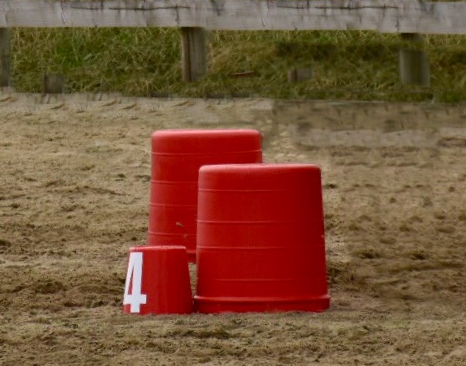
The Two Barrels obstacle is designed to test a rider’s precision and a horse’s symmetry and balance. It may look simple—but it requires thoughtful execution and subtle communication.
 Obstacle Description:
Two upright barrels are placed 4 meters apart. The rider performs a circle around the first barrel, crosses perpendicularly through the midpoint between the barrels, and completes a matching circle around the second barrel.
 Key Expectations:
The second circle must match the first in size and shape
The crossing must be straight through the center, meaning the rider should pass perpendicular to the midpoint between the barrels.
Execution should reflect correct bend, balance, and the appropriate gait for the level
 Gait & Lead Change Requirements by Level:
Preparatory & Introductory:
 Entire obstacle ridden in walk or trot, rider’s choice
 No change of gait within the obstacle
Preliminary:
Entire obstacle must be ridden in trot
Novice:
Ridden in canter, with a lead change through walk or trot at the center
Elementary:
Ridden in canter, with either a flying change or a lead change through walk
Medium:
Ridden in canter, with a flying change required at the center
 What Judges Look For:
Even, round circles with correct bend
Consistent rhythm and impulsion
Straightness and alignment when crossing between barrels
Level-appropriate lead changes
Harmony between horse and rider with minimal visible aids
 Training Tips:
Build your first circle based on your horse’s weaker side—this helps ensure the second circle (on the stronger side) matches in quality
Bigger circles = better balance. Don’t make them too small—quality of bend and rhythm matter more than tightness
Avoid micromanaging or overcorrecting—this can put your horse off balance and disrupt flow
Ask for bend with your seat and inside leg, not excessive rein. Rein aids should guide, not force
The Two Barrels obstacle isn’t just about riding two circles—it’s about demonstrating control without tension, bend without force, and precision without pressure. When ridden well, it showcases the refinement and partnership at the heart of Working Equitation.
 Virtual Working Equitation