
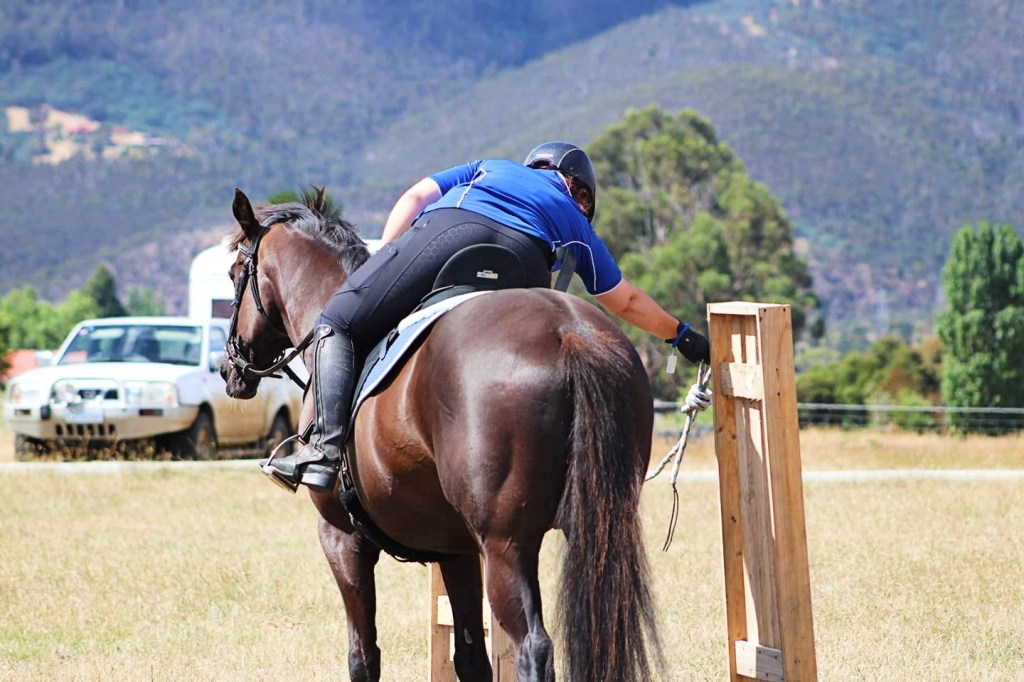
The Rope Gate obstacle is one of the most technical and revealing elements in Working Equitation’s Ease of Handling phase. It tests the partnership between horse and rider, requiring precision, calmness, and clear communication.
Rope Gate Construction Guidelines
A well-constructed gate is critical for safety and smooth execution. :
- 📏 The opening width must be at least 2.0 metres, with a minimum gate post & sides height of 1.3 metres according to WENZ standards.
- ➰ The rope must include a rope loop attached on the post, which can be easily detached and handled by the rider from horseback.
- ⚠️ Safety is paramount: all hardware should be secure, with no sharp edges or exposed screws near the horse’s legs or hooves.
- 🏗️ The supporting posts need to be stable and firmly fixed.
- 🚫 Ideally, avoid using jump stands with wings or stands with stabilizers that stick out too far, as these can interfere with the horse’s foot placement.
- 🏡 For virtual courses, we understand you may use whatever is available on hand—just be aware that protruding parts can affect your horse’s ability to navigate the gate accurately and may cause tension if they step on parts of the gate legs.
Why Is the Gate So Technical?
The gate obstacle demands more than just opening and passing through. Key challenges include:
- 🎯 Maintaining control and balance while performing precise movements and rein-back.
- 🐴 The horse must remain calm and attentive, even while halting and reversing close to a potentially intimidating structure.
- 🧍 The rider must use clear, coordinated aids to guide the horse through approach, halt, reverse, open, pass through, and depart with efficiency in steps.
- ⏸️ At Preliminary levels and below, a longer pause in the halt is encouraged to build confidence and lower the horses tension in execution.
- ⏩ At upper levels, the halt should be shorter and more fluid to maintain momentum and rhythm throughout the gate execution.
- ❌ Any crooked movement, hesitation, or dropping the rope can lead to penalties and missed marks.
- 🔄 The gate tests the horse’s ability to switch between forward momentum stillness, and backward movement seamlessly.
Level Requirements for the Gate Obstacle
At all levels, no transition markers are placed on the course for the gate obstacle. Instead, riders must:
- Complete a transition to walk before making the quarter turn into the gate.
- After departing from the gate, transition to the required gait for navigating between obstacles in your competition level.
- Use one hand on the reins and one hand on the rope while negotiating the gate. This is mandatory for all levels where the rope is held.
Introductory Level
- ⬆️ Approach the gate directly facing the gap between the posts.
- ↰ Make a quarter turn to halt parallel to the latch or rope loop.
- 🖐️ While halted, pick up and replace the rope.
- ⬅️ Depart straight forward from the halt position — no rein back or passing through is required.
Preparatory Level
Competitors can choose from three options, each with different maximum scores:
- Option 1 (Max 4 points): Approach facing the gate and quarter turn to halt parallel to the latch. Pick up the rope and reverse straight (without swinging hindquarters) to the hinge post. Halt and replace the rope. Pass through the gate or depart straight forward without passing through.
- Option 2 (Max 6 points): Perform the Preliminary and above gate pattern without the rope. Simulate rope handling by touching the posts.
- Option 3 (Max 10 points): Full gate pattern with the rope as required at Preliminary and above.
Preliminary Level and Above: Forward Through Gate
- ↰ Approach facing the center gap, then quarter turn to halt parallel to the latch post.
- 🖐️ Pick up the rope and reverse 2-3 straight steps, parallel to the gate.
- 🅄 Move forward and pass through the gate, then turn to halt parallel on opposite side.
- 🔙 Reverse straight to the latch post, halt, and replace the rope.
- ⬆⬅ Depart with a quarter turn away from the gate if space allows.
Novice Level and Above: Reverse Through Gate
- ⬆️ Approach the gate perpendicular (right angle) toward the latch post.
- ↰ Quarter turn to halt parallel to the gate facing the hinge end.
- 🖐️ Pick up the rope.
- ⬅ Move straight forward several steps until horse’s hindquarters are at the center of the gate opening.
- 🅄 Reverse through the gate, turning 180 degrees to face the opposite direction.
- ➡ Move forward up to latch post.
- 🖐️ Halt and replace rope.
- ↲ Depart with a quarter turn away from the gate.
Speed Round Requirements for the Gate
- ⚡ In Speed rounds (from Preparatory level and above), the gate is handled quickly and fluidly
- 1️⃣ Preparatory Speed rounds require Option 1 gate execution: approach, quarter turn and halt parallel, pick up rope, reverse straight to hinge post, hang up rope.
- ❌ No halts are required in Speed rounds at any level.
- 🖐️ One hand on the reins and one hand on the rope remain mandatory.
Training Tips for Successful Gate Navigation
🐎 Keep the Feet Moving (But Slowly)
During turns and positioning near the gate post, focus on keeping all four feet lightly moving. Avoid letting any foot become “stuck,” which can cause tension and unbalance your horse. A fluid rhythm during these movements helps maintain engagement, balance, and softness.
🐢 Slow, Precise Steps Are Key
Rushing the gate makes it difficult to apply subtle corrections. Keep each step deliberate and controlled. Fewer corrections mean your horse remains calm and responsive, which is crucial for scoring well.
🧩 Break the Gate Into Small Steps
Practice each part separately without the rope before combining movements. For example, the full gate steps are:
- Approach and halt parallel to the latch post.
- Reverse 1–2 straight steps.
- Move forward and pass through the gate.
- Turn and halt parallel on the opposite side.
- Reverse to the latch post and halt.
- Quarter turn away and depart.
Once fluent, add the rope and build up the full sequence.
🔄 Vary Your Patterns
Don’t practice the gate in the exact same way every time. Occasionally finish at a different point, or walk straight forward instead of turning through. This teaches your horse to wait for your aids rather than anticipating the routine as a trick.
Final Thoughts
The gate obstacle is a beautiful test of communication, timing, and technique. By understanding the progressive training levels, you can build a partnership that rides the gate with confidence and accuracy.
Whether you’re at Introductory level or competing at the highest levels, thoughtful preparation and mindful riding make all the difference.
 Virtual Working Equitation