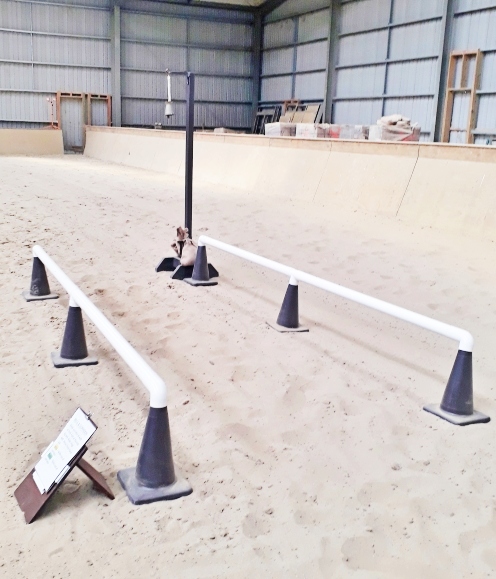
 Setup requirements:
• Two poles forming the corridor
- Placed 1.5m apart (may be slightly wider for horse with handler on the ground)
- Poles may be placed at ground height or raised up to 30cm
• An upright mechanism at the end of the corridor to hold the bell
• Bell height approximately 2 metres
- The bell may be positioned lower or hung on a longer cord to allow smaller riders to ring it safely
✦Training show allowance:
Slight variation is permitted for the virtual show so that we can accomodate the 20x40m arena size and obstacles that participants have on hand while maintaining the intent of the obstacle.
Length of the corridor may be less than 3.5m – but we advise no less than 2m at Intro/Prep and 2.5m for Prelim and up (L shape long part)
Height of the corridor sides may be lower than stated in competition rules
What Judges Are Looking For
The Bell Corridor primarily tests the horse’s ability to remain calmly immobile while the rider performs a task. This is the foremost and most important quality of the obstacle.
✦Judges will also assess:
Straightness on entry and through the corridor
- The horse’s ability to transition to a calm, balanced halt
- Calm immobility while the bell is rung
- Readiness to depart from the halt without tension or resistance
- Maintenance of balance from halt to either a forward exit or a reverse (from Preliminary level and above)
- Rhythm in forward steps and rein back
- Increasing self-carriage and agility at higher levels
- Confidence and understanding of the horse
- No contact of the horse with any part of the obstacle
- Use of consistent hand to ring the bell
- A smooth, organised exit
✦Gait requirements and degree of difficulty:
- Intro & Prep: Walk is compulsory within the obstacle
- Prelim: Walk or trot permitted
- Novice & above: Walk or canter permitted
A progressive transition to halt is allowed. When performing trot or canter into the obstacle, the progressive steps should be minimal. If more steps are needed to achieve a smooth halt, it is preferable to transition to walk outside the obstacle to avoid interrupting rhythm within the Bell Corridor. There is no judging penalty for executing the obstacle at walk at any level. However, the degree of difficulty attempted and the horse’s ability to transition to a calm and balanced halt at the chosen gait are considered when awarding marks.
Training Tips for Bell Corridor Success
✦ Prioritise the transition to halt and immobility:
- On initial training, gain relaxation in the bell corridor first. This may require no halt within the bell corridor. Pass through the corridor with some slower steps to enable your horse to understand the task. Each pass through slowing the steps gradually until achieving a smooth halt without resistance.
- Do not ring the bell until your horse is able to wait quietly beside the bell. Reaching for the bell can unbalance the horse and cause them to move.
- Practice a small reach toward the bell first to see if the horse has the required balance and understanding of the task to stay still.
✦ Develop straightness:
- Prepare for the entry with enough time to transition smoothly (if transitioning) and align with the entry so that a straight line in the corridor is achieved.
✦ Prepare for departures:
- The key to a good departure is first achieving a balanced halt. Ensure your horse has straight alignment from head to tail befire asking for a forward or backward step. Gather yourself to indicate the impending transition and create space with your own body for the horse to pick up their steps rather than fall or lean into the transition.
- To ensure attentiveness without anticipation, do not practice the same pattern repeatedly. If you are training for rein back exit, then make slight variations in what you ask, e.g. sometimes exit forward, or rein back 2 steps and then walk out forward.
We can’t wait to see your skills in action. Happy Training!
 Virtual Working Equitation