
 Setup requirements:
Preparatory & Preliminary (Requirements for VWE course):
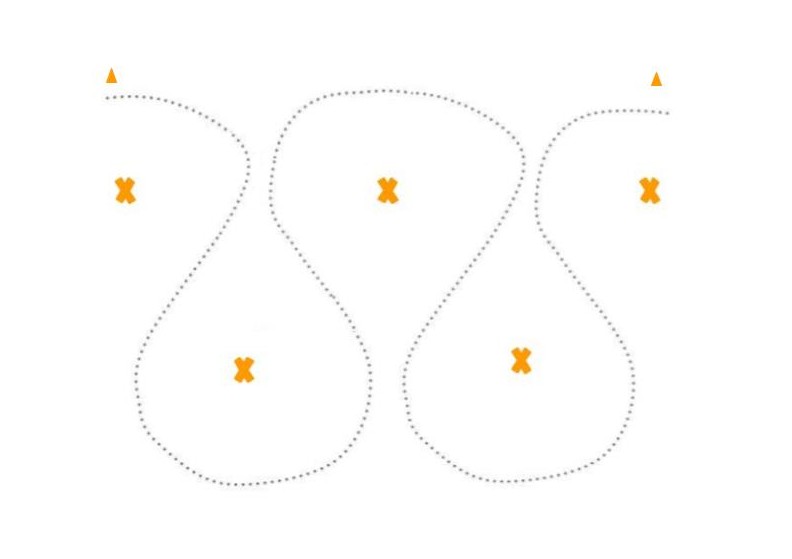
• Two slalom lines using 5 poles
• Initial line of 3 upright poles or cones spaced 7 m apart
• Second line of 2 poles placed 7 m from the first line, evenly positioned at the centre point between the gaps
Novice and above (Requirements for VWE course):
• 8 m spacing between poles/cones and between each line with a total of 5 poles
Transition markers are placed with adequate space for size of circles at the entry and exit of the obstacle
✦Training show allowance:
Slight variation is permitted for the virtual show so that we can accomodate the 20x40m arena size while maintaining the intent of the obstacle.
A 7-pole configuration is not feasible with this arena size for Elementary and Medium levels so these levels will be using a 5-pole setup.
 Gait Expectations
Preliminary: Trot
Novice: Canter (due to 5 pole setup in this course otherwise trot option allowed for 7 pole setup)
Elementary / Medium: Canter
What Judges Are Looking For
• A consistent size circle or loop around each pole with the horses spine following the arc of the circle.
• Circle or loop size appropriate to the horse’s level and gait
• Bend change timing and path of travel centered between previous and next poles
• Fluid execution without loss of balance or rhythm
• Correct gait maintained throughout
• A calm, confident, harmonious picture
Canter-specific requirements (where applicable)
 Correct canter lead maintained around each pole
Balance maintained during change of lead
✦Lead change requirements by level:
Novice: Lead changes performed through walk or trot
Elementary: Lead changes performed either through walk or as a flying change
Medium: Flying lead changes required
Training Tips for Double Slalom Success
❖ Begin training with wider spacing (around 10 m) or larger circles to allow the horse time to recover balance and reduce pressure
❖ Start at walk, focusing on preparation and clarity of line before increasing gait
❖ Prepare for the change of bend early allowing your horse to organise their body
❖ Use small, subtle corrections to preserve flow without creating tension
❖ Expect improvement over repetitions rather than immediate results
❖ Encourage relaxation, particularly if the horse rushes or shows tension.
❖ Avoid overcorrecting asymmetries; instead, aim for gradual, symmetrical development
❖ Support training with lateral work away from the obstacle to improve flexibility and balance
 A well-ridden double slalom demonstrates suppleness in both directions, steadiness, stamina, and the ability to maintain accuracy, balance, and fluency through repeated changes of bend and lead.
We can’t wait to see your skills in action. Happy Training!
 Virtual Working Equitation